The science of the spotlight effect, and how to stop letting imaginary judgment run your life.
Think back to the last time you felt embarrassed in front of other people.
Maybe you stumbled over a word in a meeting, walked into a room and realized your outfit was all wrong, or shared an opinion and immediately wished you could take it back. Whatever it was, you probably replayed it that night, certain that everyone had noticed, everyone was still thinking about it, and everyone had probably downgraded their opinion of you.
Here's what a psychology study proves: almost nobody noticed. And the few who did forgot within minutes.
This is one of the most freeing ideas I've ever come across, and it's the subject of my latest episode. Below is the science behind it and what to do with it.
The thought that runs through almost everyone's life
Over the past few years, I've paid close attention to something in nearly every person I meet, and in myself. Before we do almost anything that involves being seen, there's a flinch.
What are they going to think?
Before posting the thing. Before speaking up. Before wearing the outfit. Before sharing the idea. That thought pops up, and for a lot of us, it wins. It keeps us quiet and safe.
Here's the question I started asking back: So what if they do think something? What's actually the worst that happens?
Because people are going to have opinions no matter what you do. You could shrink yourself down to nothing, and someone would still find something to say. So you might as well do the thing anyway.
Then I came across research explaining exactly why that flinch is lying to us.
The Barry Manilow experiment
In 2000, psychologists Thomas Gilovich, Victoria Medvec, and Kenneth Savitsky published a study in the Journal of Personality and Social Psychology that gave this feeling a name: the spotlight effect.
The setup was almost comically simple. They asked college students to put on a T-shirt featuring a large photo of Barry Manilow, a singer the students had rated as uncool at the time, and then walk into a room full of other people. Peak self-consciousness, engineered on purpose. Then they asked the T-shirt wearers a question: What percentage of people in that room do you think could identify who was on your shirt?
The wearers were sure. On average, they guessed that about half the room had noticed their embarrassing shirt.
In reality, only about 23% actually could. The wearers had imagined an audience more than twice the size of the one that actually existed.
It wasn't just about the embarrassing shirt
The researchers suspected someone might argue the result away: maybe a goofy, embarrassing singer is just forgettable. So they ran the experiment again, this time letting students wear shirts they actually liked, featuring people they admired: Bob Marley, Martin Luther King Jr., Jerry Seinfeld.
People still overestimated how many others had noticed them.
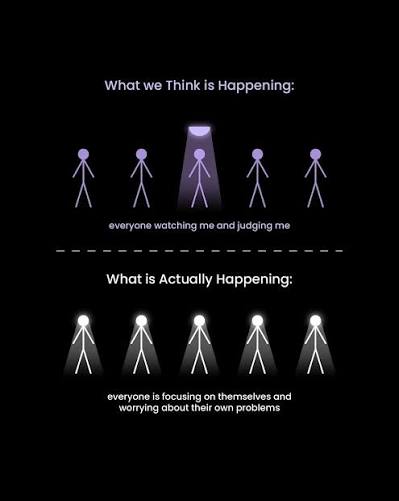
The lesson is that we walk through life convinced there's a spotlight following us, illuminating every choice, every mistake, every flaw, when in reality, everyone else is starring in their own movie, worrying about their own spotlight.
Why do our brains do this?
The spotlight effect comes from something psychologists call egocentric bias, which is a quirk of being trapped inside your own head.
You experience your own life at full volume. You are the absolute center of your own attention, aware of every word you say, every bead of sweat, every awkward pause. Because that experience is so vivid to you, your brain makes a lazy assumption: that it must be just as vivid to everyone else.
But it isn't. Other people are experiencing their own full-volume lives. The stranger you're sure is judging your presentation is quietly worried about their own coming presentation, email, their own posture, the thing they said an hour ago, or how they would perform in the same situation. Everyone is the star of their own show, and a barely-noticed extra in everyone else's.
It gets even more freeing: they judge you less harshly, too
A follow-up line of research by Savitsky, Epley, and Gilovich found something that goes one step further. Not only do people notice our mistakes far less than we assume, they also judge those mistakes far less harshly than we fear.
We assume one mispronunciation or fumbled sentence defines us in someone's eyes. In reality, observers tend to be far more forgiving of our blunders than we are of our own, partly because they barely registered them, and partly because they, too, know what it's like to stumble. Your worst moment is a footnote in someone else's day, if it registers at all.
What this means for public speaking, posting, and just being yourself
So much of what we call stage fright, social anxiety, or fear of judgment is really just the spotlight effect running unchecked. We perform for an audience that is far smaller, far less attentive, and far kinder than the one in our imagination.
Speaking up costs less than you think. People are not scrutinizing your every "um." They're barely tracking it, and they'll have forgotten it before they reach their house.
Your mistakes are not permanent records. The thing you're still cringing about from three months ago? The other people involved almost certainly don't remember it. That memory is yours alone. You are likely overthinking.
Being yourself is nearly risk-free. If the harsh audience is mostly imaginary, then wearing the thing, posting the thing, and saying the thing carry a fraction of the social risk your brain is quoting you.
You can use the spotlight effect in reverse. Because people barely remember your stumbles, every imperfect attempt is essentially a free practice run. That's a cheat code for building confidence: you can afford to be bad at something in public, because the public isn't keeping score.
How to put this into practice this week
Understanding the spotlight effect intellectually is one thing. Rewiring the flinch takes small, deliberate reps. Here's where to start:
Try the "would I even remember this?" test. Next time you're sure everyone noticed your mistake, ask yourself honestly whether you'd remember the same slip if a stranger had made it. You rarely would, which tells you how much they'll remember yours.
Do one thing you'd normally avoid out of self-consciousness. Speak up once in a meeting. Post the thing you drafted and deleted. Wear the outfit. Collect the evidence that the sky doesn't fall.
Remember that the discomfort fades faster for them than for you. You'll replay it; they've already moved on. Let that gap work in your favor.
The bottom line
The audience you're so afraid of, the one keeping score of your every flaw, was never really there. The spotlight you feel is a trick of your own perspective, not a fact about the world.
The only thing standing between you and speaking up, showing up, and being fully yourself is a fear built on a mistake your brain keeps making.
Remember, you are your biggest critic, and if people judge, what happens next?
I go deeper on the spotlight effect, the science, and how to stop letting imaginary judgment write your story, in my latest episode. Watch it here: Give Me 10 minutes To Make You Dangerously Confident
If this resonated, share it with someone who needs to hear that nobody's watching as closely as they think. And let me know in the comments: what's one thing you've been holding back on because you were scared of what people might think?
Sources
Gilovich, T., Medvec, V. H., & Savitsky, K. (2000). The spotlight effect in social judgment: An egocentric bias in estimates of the salience of one's own actions and appearance. Journal of Personality and Social Psychology, 78(2), 211–222.
Savitsky, K., Epley, N., & Gilovich, T. (2001). Do others judge us as harshly as we think? Overestimating the impact of our failures, shortcomings, and mishaps. Journal of Personality and Social Psychology, 81(1), 44–56.